Flay Your Influences: Jessi MacEachern in Conversation with Sarah Burgoyne
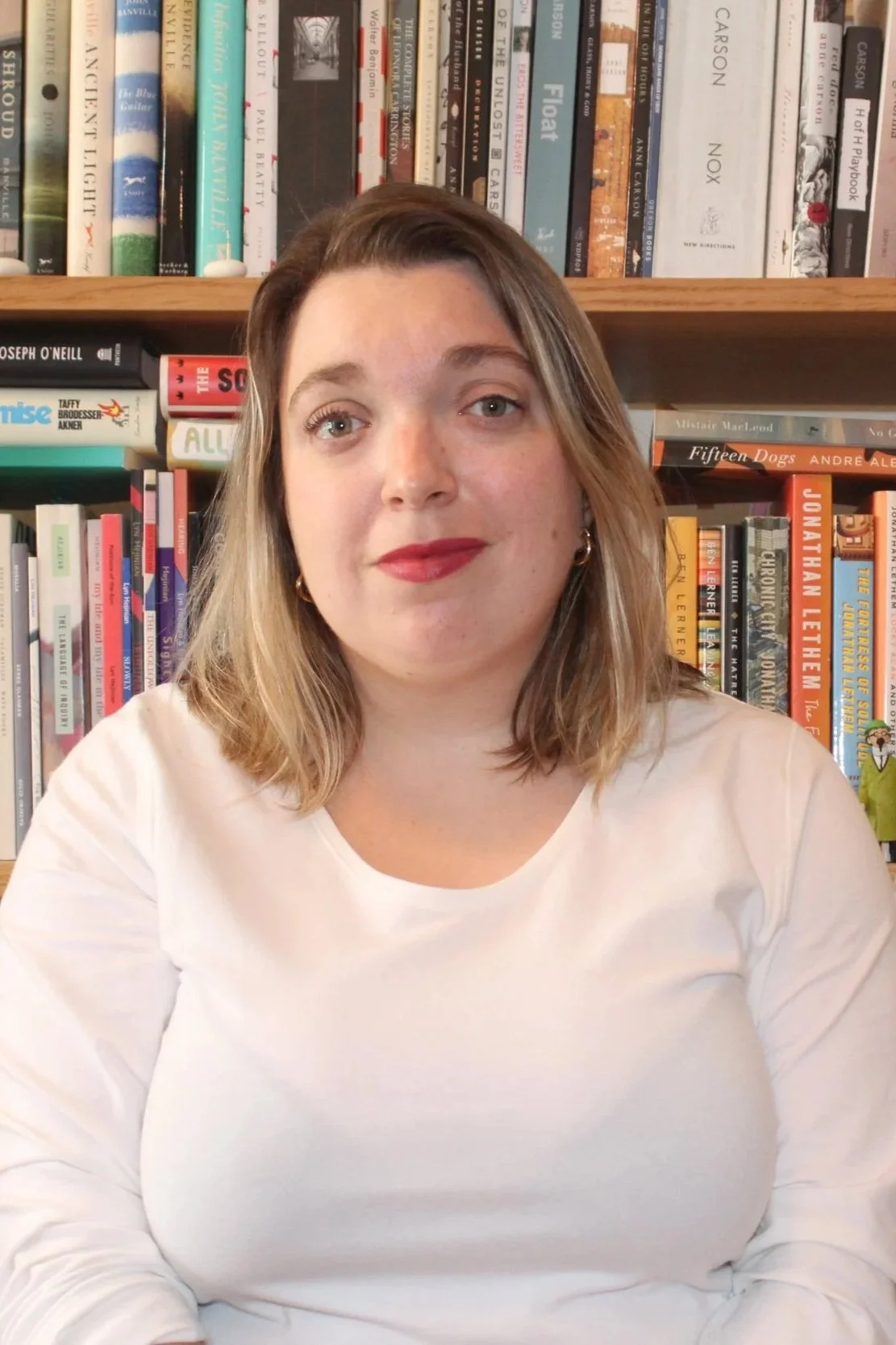
Photo credit Jessi MacEachern
Jessi MacEachern is a poet who lives in Tiohtià:ke/Montréal. Her two poetry collections, Cut Side Down (2025) and A Number of Stunning Attacks (2021), were published by the small, scrappy, Canadian press Invisible. New poems are available or forthcoming in Yolk, This Magazine, and The Dalhousie Review. Her new chapbook The Nose on Her! is forthcoming with Turret House in 2026.
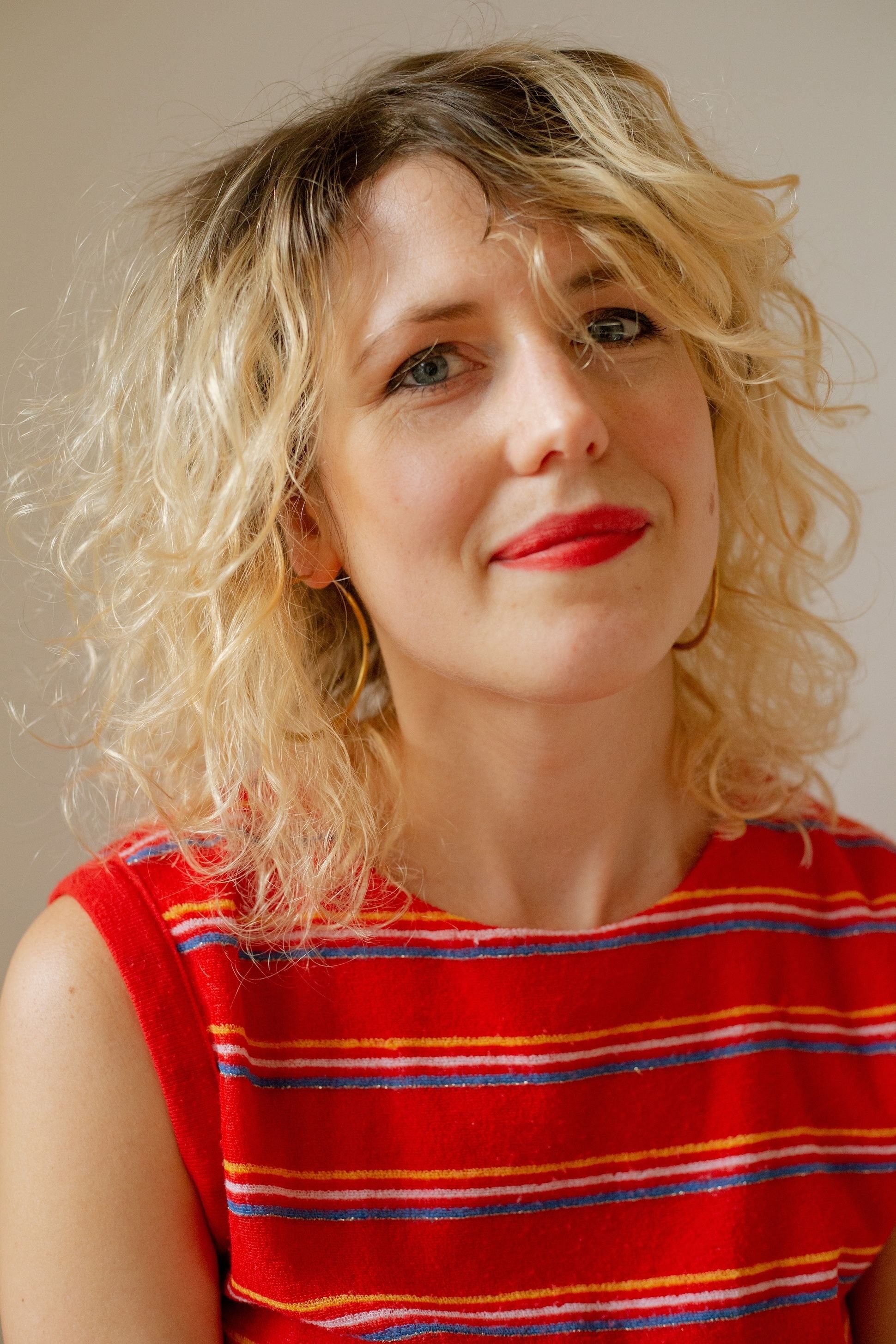
Photo credit Laurence Philomène
Sarah Burgoyne's two poetry collections, Because the Sun (Coach House, 2021) and Saint Twin (Mansfield, 2016), were finalists for the A.M. Klein Prize in Poetry. Saint Twin was awarded a prize from l'Académie de la vie littéraire (2017) and shortlisted for a Canadian ReLit Award. Her most recent book is a collaboration with American poet Vi Khi Nao called Mechanophilia (Anvil, 2023), an infinite poem based on the number pi, and also a Feed Dog Book, an imprint of Stuart Ross. She has been published widely across Canada and the US and her latest publication can be found in Poetry Magazine.
"Flay your influences! Veer into the future(s)!" exclaims Jessi MacEachern midway through this delightful, brilliant conversation with fellow poet Sarah Burgoyne. The phrase serves as an apt invitation into MacEachern’s newest collection, Cut Side Down (Invisible Publishing, 2025), which is filled with body horror, dreams, literary hauntings, unruly desires, and the push and pull of the sea. In this interview, MacEachern and Burgoyne discuss poetry's debts and departures, the generative possibilities of revision, feminist and queer play, and the shifting relationship between the body, memory, and imagination. So, let’s veer, shall we?!
Sarah: Dear Jessi, I want to start off by asking you about the “outsides” of the book… the sort of biological casing you’ve swathed your poetry in, including the title. But first, tell me about the cellular pools we see grinning through the stencils on the blue cover of your second collection’s title, Cut Side Down.
Jessi: That’s the work of Invisible’s cover designer, Megan Fildes, who interpreted my mood board of cover ideas in the direction of the natural and the biological. It’s certainly a less frightening result than the number of Cronenberg stills I had sent her might have prompted. In a text I received from my publisher, Norm, he clarifies it’s a collage of two images: one of a childhood skin disease, and one of Japanese algae. I was immediately drawn to the vivid contrast of the blue, too saturated to be quite the color of sky, with the sweaty flesh-like wounds. I think (I hope?) it prepares the reader for the mix of body horror and gynecological humour inside some of the poems.
Sarah: This is so fascinating, and I will ask you more soon about this blessèd category you’ve now coined “gynecological humour.” But first, you’re telling me the book is enveloped in childhood skin disease (which one I wonder?) and Japanese algae, which introduces, to my mind, a host of themes: childhood, rot, sickness, itchiness, sorrow, exposure, mothers and also, the sea, salt, healing, health, flavour, fish, flow. All of these themes are held up perhaps in a type of paradoxical relation. Can you tell me more about them, or which ones were most present with you in the writing of Cut Side Down?
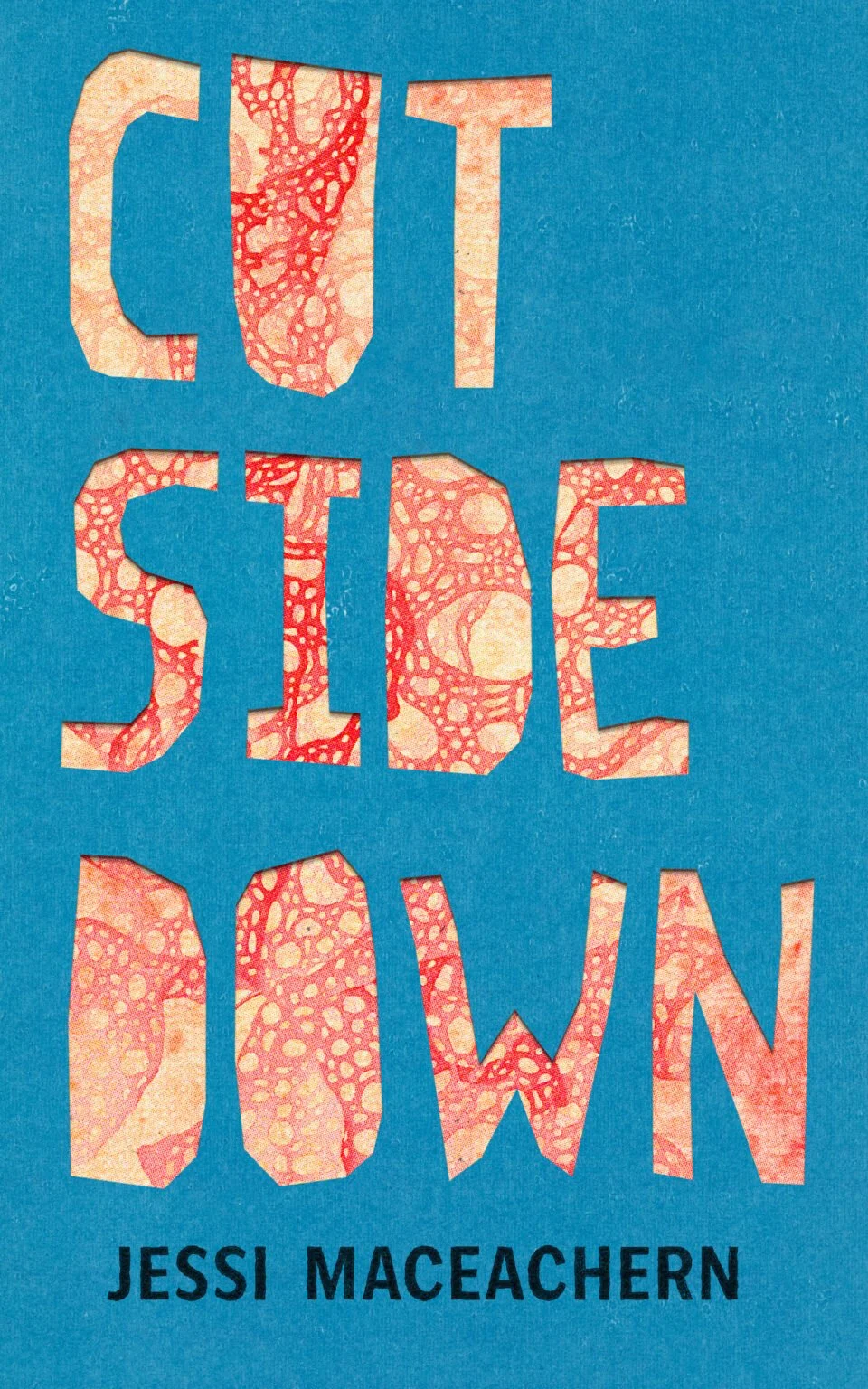
Jessi MacEachern, Cut Side Down. Invisible.
Jessi: A lot of those themes are present in the poem “If It Rots”: rot, of course, but also the sea, salt, flavour, and fish. Childhood is alluded to in the presence of the father, who is scolding the adult daughter for her poor knowledge of all these things. I think there’s a concentration of these concerns toward the end of the book, when the poems finally remove their heads from the women’s writing (Woolf, Niedecker, Gladman) they had been using to throw their voices in other pitches — that is, when the poems pick up on details more generally “autobiographical,” I suppose. The “red dirt” of these poems is that of PEI, where I grew up, and, I think, it stains the final pages more heavily than the rest of the book.
Sarah: I had noticed the poems starting to wade into autobiographical waters in the final section “When a Folk, When a Sprawl,” which I especially loved. In “If It Rots” the speaker in the kitchen has to work her mouth around “FLAY” and “VEER” on opposite sides of the page with a tipless, featherless arrow between them, almost like two arms holding them apart like an “eagle, ready for the spread” (45), and I wonder, perhaps touching back on the body horror à la Cronenberg you mention above, if the process of writing Cut Side Down involved both of these exciting, violent verbs?
Jessi: The phrase “cut side down” first conjures for me an image of a book flayed open, as if our reading of it has permanently disfigured the spine. It’s a minor but delicious kind of violence, and it was involved in the reading method I practiced on the artworks that inspired this book. To veer is to change course, to improvise, to stun or surprise. It felt necessary to enact these turns in the poems, both to make them my own (and thus appropriately distinct from the source material) and to get away from the reality, truth, or facts of life I was living beside them. Flay your influences! Veer into the future(s)! I guess that’s how I’d describe the book’s writing process.
Sarah: Can you say more about this particular reading method? I always find your methods so inspiring (I almost wrote “inspiriting”).
Jessi: For a number of these poems, the impetus to write was that I found I could not. I was lacking inspiration, or feeling like I did not have sufficient time (I was still writing my dissertation, which felt like it was stealing so much from what could be poetry). I was, however, reading, and all my favourite teachers (Gail Scott, foremost among them) had always insisted reading was the first step in writing. So I began keeping notebooks and documents consisting of my favourite lines or sentences, as well as my responses to them, performing in some cases bad translations of the syntax and content, to see if I could mimic the “spirit” that grabbed me while reading. This led to years of not so fruitful rearranging of half-robbed lines, until I sat down to write the poems anew. It’s a largely frustrating way to write, so I don’t recommend it, but it was a way for me to carve out new thought and new sound.
Sarah: In my experience, frustration is the best friend of poets. You telling me your dissertation was half-robbing poetry makes me think of Orphée in Jean Cocteau’s film of the same name, who, put on trial, is asked if he’s a writer to which he responds he’s a poet. What’s the difference, he is asked. To which he replies, a poet is “to write, without being a writer.” In the first film of this trilogy, The Blood of the Poet, the artist moves, dream-like, through a long hallway, stopping at each door to peer through the keyholes. Your book is described as “spying through the keyholes of fantasy.” I suppose I have two questions: as a poet, is everything you do connected to poetry in some way? And also, what is the fantasy you are hoping your reader will spy through the keyholes of your poems?
Jessi: There are some elements of life that feel unconnected to poetry (taxes, weeknight dinners, exercise routines), until my being a poet becomes the inevitable excuse for why I’m doing them badly or, at least, a little strangely. I’m becoming more comfortable identifying as a poet, but I’m not entirely sure that is a good thing, for myself or for poetry, ha! But it’s a fact that every notebook I own has poetry in its pages. The line, the enjambment, the concentrated image: that’s my natural syntax. Those keyholes, I’m so happy there’s a connection to Cocteau. I haven’t seen the film trilogy so I was not alluding to that poet’s exact trajectory, but I was thinking of the long history of literature and the many narrators who spied exciting (usually sexual) adventures from a hiding spot in a closet, hidden room, or hallway. I want the reader to be a little titillated, a little shocked, and a little inspired. Sometimes it’s just a child with her head in a book they see, but her expression is one of faraway dreams. Sometimes it’s the dreams themselves, which are largely indescribable, except in the language of poetry.
Sarah: In my book, your identifying as a poet is an entirely good thing for poetry! Who else could don the mantle with such gusto, skill and elegance? The trifecta of titillated-shocked-inspired is an excellent description of the many moods of Cut Side Down, which I designate as a sort of punk collection, which is one of my most respected forms of art (and attitudes). This trifecta reminds me of the three spires of the moustache in “Evening’s Predatory Landing”: “each papa’s moustache curiously waxed / into three rising spires” (19). There’s gender-play in much of your work (I’m thinking also of A Number of Stunning Attacks), and it’s always cheeky and feminist and provocative. For example, I had never seen the waxed moustache as phallocentric spire triplets. Can you say a little about how you perceive what I’m calling “gender-play” in your book?
Jessi: Oh, how badly I wish I were remotely punk! I am a soft little woman who is anything but punk. There’s the beauty of writing, though, it allows you to create a different voice, a different body even. That’s how the “gender-play” comes around as well. I identify as a woman, love being a woman, and greatly admire many women (and, relatively, very few men), but only inasmuch as that category can be expansive and ugly and intoxicating and everything in between. Everyone’s allowed in, so long as they have one eye on history, one eye on the future, and a body full of embarrassing secrets. A lot of my poems are ways of letting out some of those embarrassing secrets, which include descriptions of body hair, gender nonconformance, and unruly desires.
Sarah: And yet, I fail to read “embarrassment” in these poems. To me they are unapologetic, often hilarious, extremely witty and, well, punk! You can’t title a poem “Cunt Was Her Favourite Word” and write so much about sex and longing without decorating your verse with fashionable safety pins. In the very first poem, perhaps the introduction to the work, the unnamed poem that is not listed in the contents and opens before the first section “Ravishing the Sex Into the Hold,” you write, “By morning / the women behind my eyes will all / be life-sized. They reveal the damage done / to the surface of worlds” (1). Are the punk paradigms you screamo within (Woolf’s, Niedecker’s, Gladman’s, Coolidge’s) life-sized behind your eyes and do you feel that reading them enabled a sneering, intelligent confidence that I am delighting in in this work? May I throw my beer bottle upon your poetry’s chaotic stage?
Jessi: Well, that cunty title is a direct quotation from an Olivia Colman red carpet appearance. I do try to embody her delightful and cheeky verve. That first section, “Ravishing the Sex into the Hold,” is most directly inspired by Virginia Woolf’s Orlando, but its atmosphere and wickedness also inevitably borrow from my love for the Yorgos Lanthimos film The Favourite, in which Colman stars. I’m glad my constant state of embarrassment is not legible in the final work. That’s due to the process of revision, which is one of excising the self-censor in me to access deeper pockets of feeling. And yeah, at times, that feeling is one of confidence, or sneering arrogance. You’ve got to be a bit prickly to put a book into the world. I like that you, seemingly, interpret that “damage” from the book’s opening poem (an unannounced opener, you’re right) as almost a forerunner (a death omen?) of the reader’s reaction. Throw your beer bottles, your whisky glasses, your platform boots at the stage of me, or my poetic avatar at least! Please!
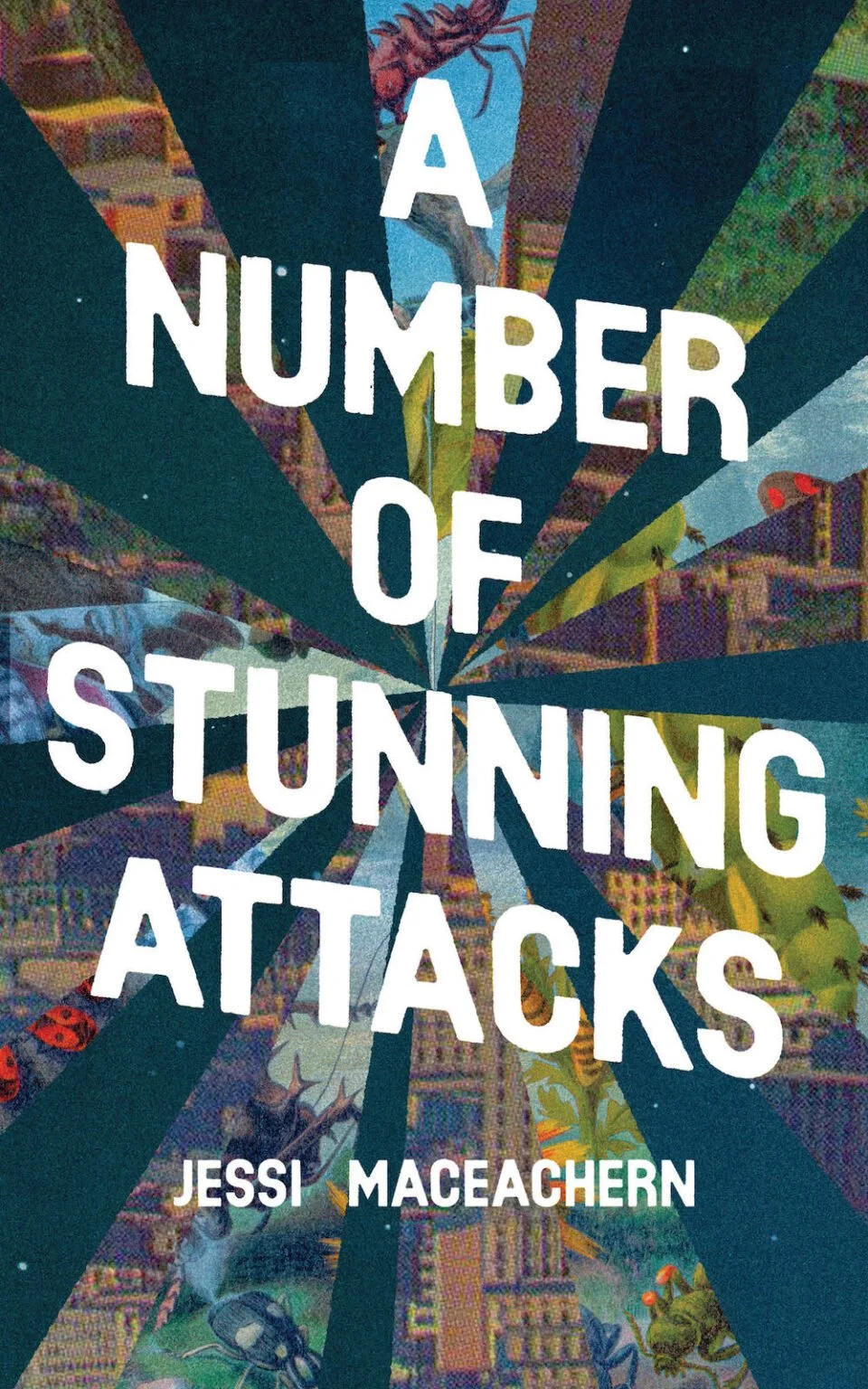
Jessi MacEachern, A Number of Stunning Attacks. Invisible.
Sarah: Tell me how you revise your work. I know you worked with the illustrious Julie Joosten for this collection and had a positive experience with her incisive eye. Is revision, for you, always dispatching the censor? Who is the censor, in your view? Do they have a three-spired moustache?
Jessi: For modesty’s sake, I’ll try not to be too effusive about the genius of Julie here, but it’s difficult to reflect back on working with her without swooning. Her eye was incisive, certainly, but it was also generative. For this book, unlike A Number of Stunning Attacks or my general experience, revision was a process of expansion. I was seldom removing words; instead, I was generating entirely new poems by having others directly talk to one another. Single-page lyrics became multi-page and multi-vocal experiments, as I tried out not just one new word but entire new identities. Julie pushed me to be more and more inventive, and it was a delight to attempt it under her guidance. She was anything but a censor, yet kindly aware of the censor within all of us: sometimes in the form of the chiding mother (sorry, Mom; and, happy Mother’s Day!). Sometimes, yes, in the ridiculous guise of a villainous patriarch whose upturned moustache refuses the rules of politesse or gravity.
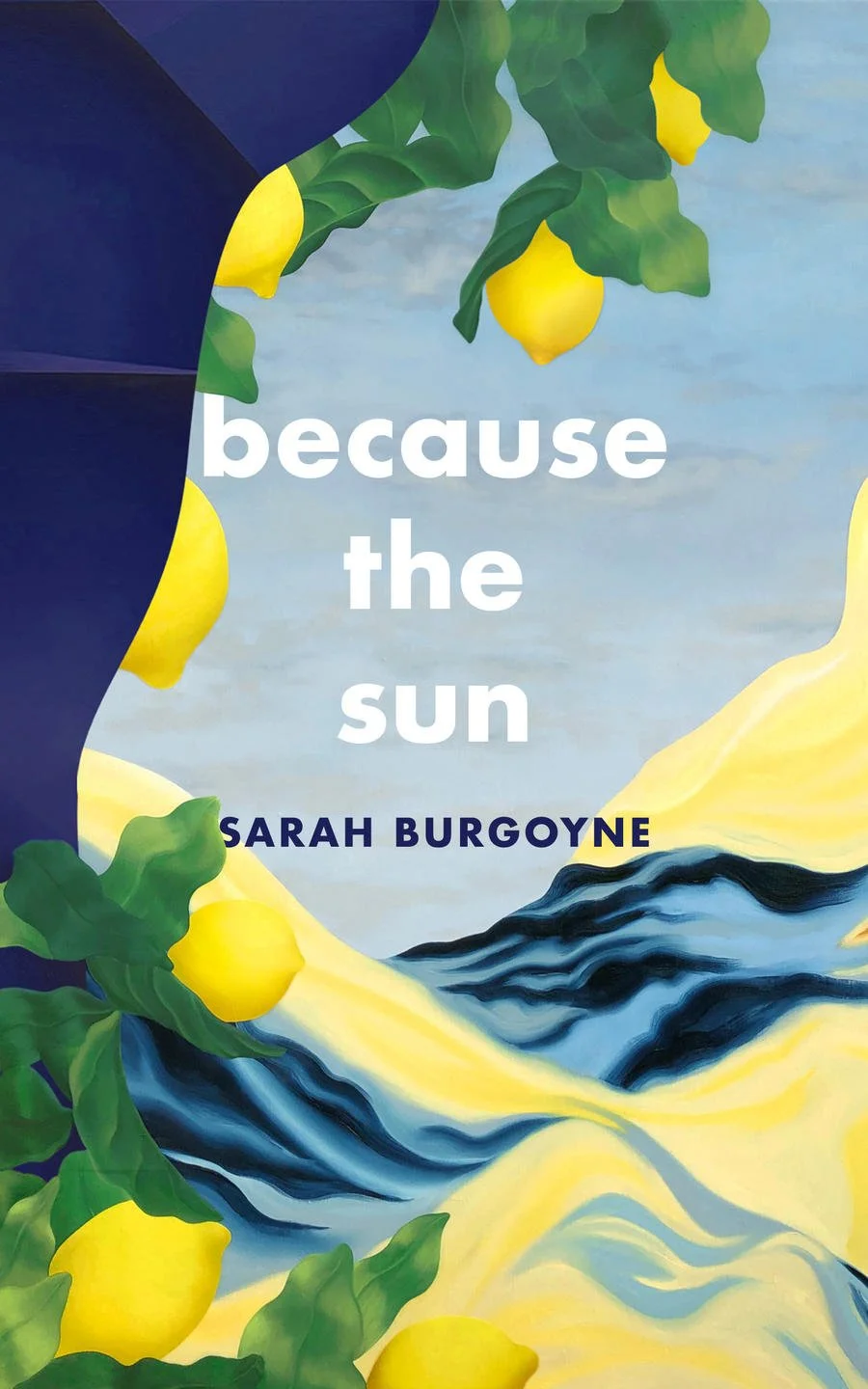
Sarah Burgoyne, Because the Sun. Coach House.
Sarah: I love this. Revision is often an experience of slashing (body horror?), or what Lisa Robertson refers to as “bonsai-ing” but I find the opposite gesture is often overlooked. When Robertson edited Because the Sun she told me to look for the parts that “don’t work” (parts where attention lagged) and to consider inflating them instead, citing Michele Bernstein, the Situationist who, I believe, borrowed the notion of “inflation” from economics and applied it to art. So, in terms of the movements of Cut Side Down, there’s the potentiality of a cut thing to either wither and die, or bloom and grow more powerfully than before. It sounds like Joosten encouraged the latter form… I suppose we call it pruning, to cut in order to enable growth, a sort of paradox. I notice a paradoxical dialectic in Cut Side Down between flesh and fleshlessness. There’s a fantasy of “permeating” in “The Twenty-First Century Invents Sound” where you write, “Who will honour my nightly fantasy of escaping / this flesh & entering the city like an odour // permeating the lusty thoughts of old dogs & rose gardens” (6) and also in “I’m My Own Little One” where you write, “I am interrogating my relationship to form / and deciding in favour of formlessness” (64), to name just a couple examples. For a book that is so carnal in many ways, I wonder about the fantasy of the ether or the ethereal. How do these co-exist for you as vectors in the spectrum of longing?
Jessi: Inflation is such a good word, and I think it applies to many a good revision strategy. Paradoxically, I was also thinking of Lorine Niedecker’s “condensery” (a metaphor for the laboratory/writing desk/factory of the poet), but in a way outside the terms of reducing or minimizing. A poem is a miniature world, and the miniature can also be inflated, rising up like a balloon, its deceptively diminutive scale hosting so many delights. The examples of flesh/fleshlessness you name capitalize on these ideas of the miniature, of being a “weird little guy” (“The Nose Drove Me Mad” 32), part living, breathing, human being and part metaphysical quandary of yearning. I guess it’s just a dichotomy I’ve always lived with, and expect many people recognize, of love and hatred for your very own body, intimate feelings that tether you to the physical plane, and the occasional sense that the real self, the real work, or something more exists outside all this pleasure- and pain-oriented fawning.
Sarah: Yes, pleasure and pain—also an interesting dialectic that I noted propels this work. When reading I kept returning to this line from “One Sweet Will Agitate A Thousand” (and I do think here the reader should note the line breaks “/”): What is love but time / in the mouth of the moon-god / consenting to be bound & gagged / honey / on the nipple of the sun-soaked warrior / recently slain, / anguish / pouring like so many waves / over the lost city?”. What is love but this, Jessi! Speaking of pleasure and pain! Tell me, please, about this billowing condensery of love.
Jessi: That’s a great example of Julie’s intervention. The original version stopped at “What is love but time,” and she challenged me to paint a more elaborate picture for the reader, worthy of the decadent setting in the previous lines of the poem. To conjure up these possibilities, I took on the time-travelling pose of Orlando and collaged ideas of classical desire and contemporary queer theory, inventing lovers to lavishly praise and letting the ghosts of the epics written in their honour haunt the white space of the poem. I’m getting away from the actual question here, or anything resembling sense, but “love” as it exists in the poetry is such a “billowing,” as you say, a material but ephemeral gesture related to fashion and ships, mother’s skirts and seasides.
Sarah: Which leads us back to the final section of the book which situates prominently the mother, the sea, the childhood, the ship collecting fish. The image that recurred for me reading Cut Side Down was that of waves lapping at the shore. I noticed it first in “Where the Waves Wear the Yellow” when the word “paduasoy,” a thick silk, keeps returning in slightly reinvented forms: “peau de soie,” “padesway,” “Padua. Say,” and then again in “When a Folk, When a Sprawl,” when the poems themselves are sucked back into the ocean of the poet’s consciousness and reemitted as themselves in slightly altered shapes, like rearranged molecules, or perhaps the gravel rearranged by lapping (at least from the British Columbian’s view). Is poetry, for you, or the writing of it, channeling of it, like the procurement of so many waves? Are you locating and agreeing to the terms of the sea when you write?
Jessi: From the islander’s view, it’s never gravel but sand, even the sand dunes, rearranged by the waves. The Atlantic Ocean, the entire expanse of it, is my favourite place in the world, especially the flow that creeps into the northeast tip of the jagged province where I grew up. Something I try to channel is the push and pull of waves on the body when you are floating on it, the most delicious feeling of freedom in the world. This has become, over time, yoked to the swells of consciousness in Woolf and her far more urban The Waves. The result is that my poetry is always partly voiced by home, but also absconding away into new territory.
Sarah: What new territory will you be godiva-ing into next, Jessi?
Jessi: I’m working on a new book of poems that more deliberately speak to surrealist art (Leonora Carrington) and esoteric or occult practices (tarot). It’s been another way to re-invent the story of the self. I’m presently trying to conceive of a shape for the book itself, for the poems are written but I want them to be contained (embraced?) by something like a lyric essay or critical coda. Maybe the better description is a fun-house, I want my readers to enter and exit through a maze of distorting mirrors. That might have to happen outside the boundaries of poetry. We’ll see.
An earlier interview with Jessi about her first collection, A Number of Stunning Attacks (Invisible, 2021), conducted by Sarah can be accessed on the Canthius website here.